

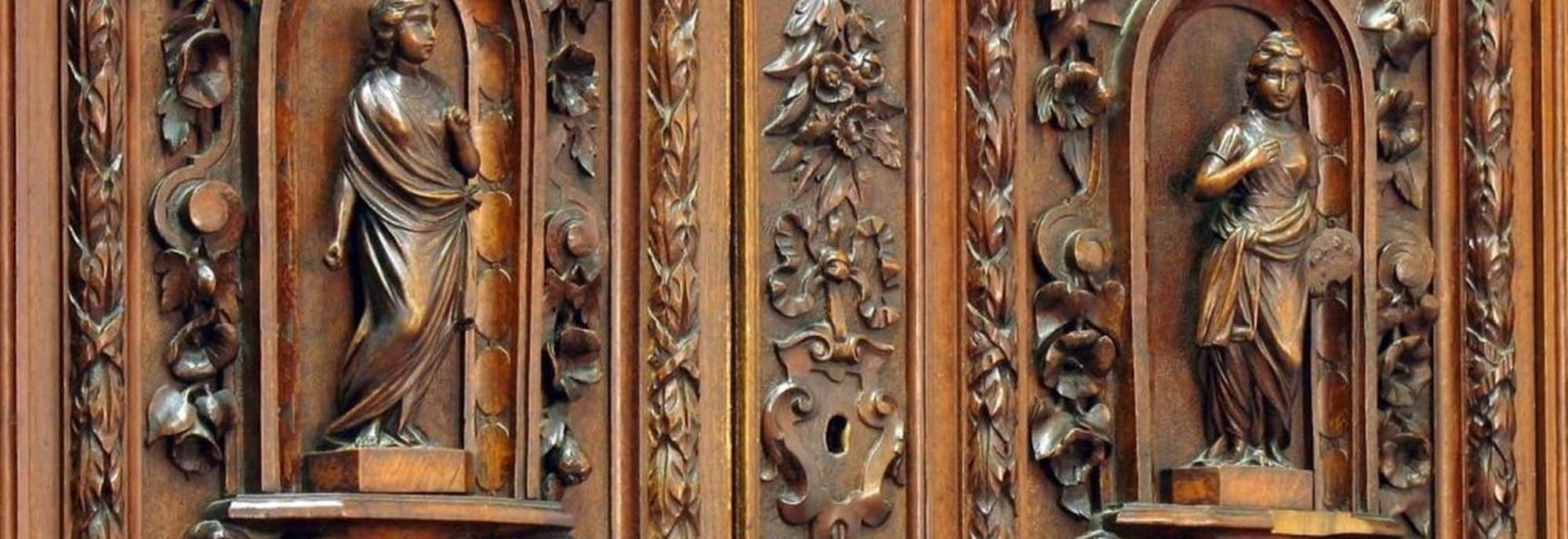
Object Research and Art-Historical Classification of Antique Furniture
Do you own an antique piece of furniture that you’d really like to learn more about? Are you unsure of the piece’s age or its original provenance? Or perhaps you’re not even sure whether it’s an authentic piece, a forgery, or a replica? In all these cases, our restoration experts at ZRW Berlin can help by conducting thorough, in-depth, and comprehensive research on the object.

How old is my furniture?
Are you planning to purchase a piece of antique furniture and want to make sure—before the sale—that it is an original and not a fake or a counterfeit? Or are you looking to sell an antique and want to provide the buyer with proof of authenticity so you can ask for a higher price?
In both cases, you should have your piece of furniture authenticated (authenticity assessment) and dated. Our certified furniture restorers in Berlin have extensive knowledge regarding
- historical production techniques and methods,
- materials used,
- original design methods,
- stylistic preferences and
- Characteristics typical of the region across all stylistic periods.
We will date your piece of furniture based on these characteristics to verify its authenticity.
Where does my antique piece of furniture originally come from?
Antique furniture has often been through a lot during its lifetime; it has been touched and moved by many hands and has found new homes time and again. As a result, it’s often not immediately clear where—or even by whom—an antique piece was made. Do you, too, wonder where your beloved antique dining table or the dresser you inherited from your grandparents actually came from?
To determine the origin of antique furniture, we conduct a provenance analysis. Ideally, this research not only allows us to roughly pinpoint the region of manufacture, but also to identify the specific workshop or the cabinetmaker who originally crafted the piece. Let’s work together to uncover the mystery surrounding the origin of your piece of furniture and explore its history.
Knowledge, Experience, Resources, Technologies
Our most important resources for reliably identifying your antique in terms of age, provenance, or authenticity are:
- our decades of hands-on experience in restoring antique furniture from all stylistic periods,
- the extensive expertise of our certified restorer (Univ.) and cabinetmaker Philipp Westebbe, owner of the Zentralen Restaurierungswerkstatt Berlin.
Based on stylistic characteristics and the manufacturing techniques used, we are able to classify most antique pieces of furniture into a specific stylistic period after just a brief examination, and narrow down their date and region of origin more precisely. Should this not be immediately possible, we draw on our direct access to scientifically sound resources. This allows us to conduct in-depth research and make an accurate classification.
In rare cases, even all of our experience, our expertise as a specialized furniture restoration workshop in Berlin, and our extensive research are not sufficient to determine a sufficiently reliable date. In such cases, we have the option of applying various scientific dating methods and conducting technological analyses to determine the exact age. If necessary, thanks to our collaboration with specialized laboratories and experts from established institutions, we can even resort to complex procedures such as determining the age of wood using IR spectroscopy.
Have the provenance, authenticity, and age of antique furniture verified
Please feel free to send us a few photos of your item in advance so that we can get an initial impression of the antique to be appraised. However, for a reliable determination of age, provenance, or proof of authenticity, it is essential that we personally inspect your antique furniture at your location in Berlin or Brandenburg. We’d be happy to provide a written appraisal detailing our findings, in which we outline and explain the results of our age, provenance, and authenticity assessments. We’ll also provide a valuation based on our findings.
Let’s shed some light on this together. We can’t wait!