

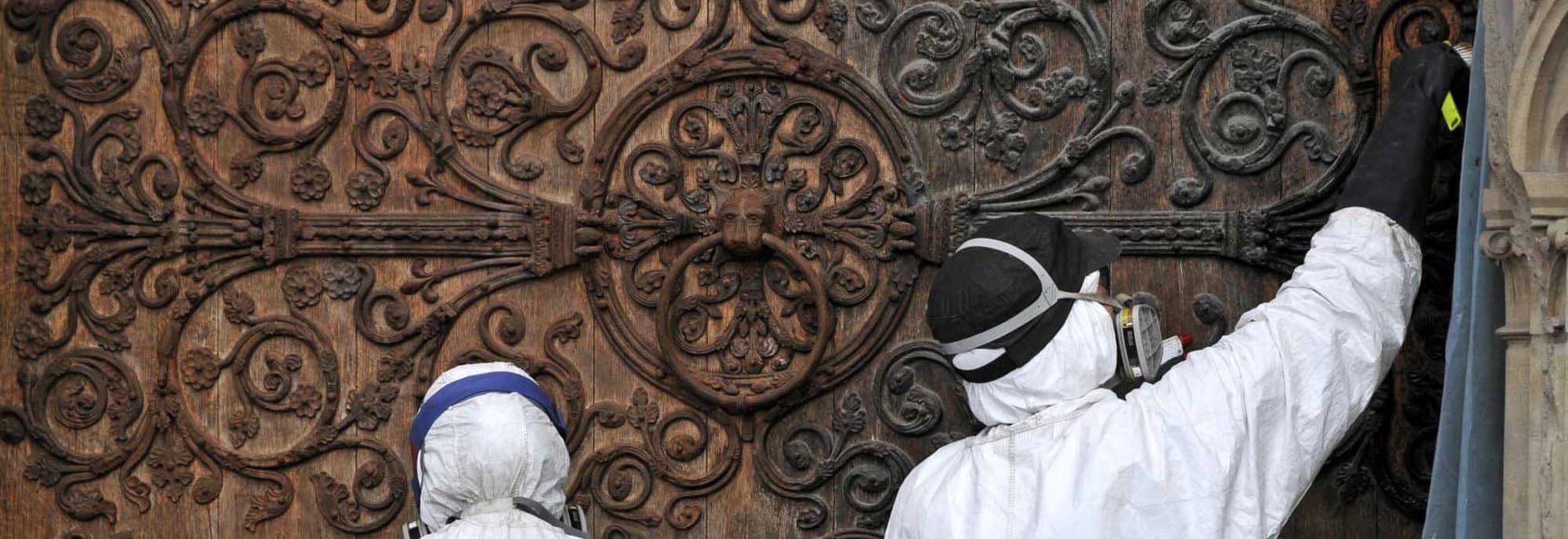

Wood restoration
The restoration of wooden objects of various kinds requires sensitivity, extensive specialist knowledge, and craftsmanship expertise. As graduate conservators, we at the Zentrale Restaurierungswerkstatt Berlin also possess many years of experience in wood restoration—whether you wish to restore a wooden floor or other utilitarian objects, from intricate relief inlays to magnificent altars. With us, private treasures are in the best hands, just as museum objects are.
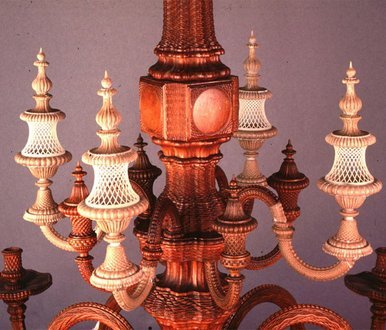
Candlesticks, wooden sculptures, or large wooden objects
Due to our extensive specialist knowledge and our enthusiasm for antiques and wooden objects of various kinds, we cover a broad spectrum of wood and furniture restoration. Our repertoire includes, among others:
- ✓
Wooden sculptures and reliefs: relief inlays, Madonna niches, sculptural works, three-dimensional artworks, crucifixes, sacred furnishings, and figures
- ✓
Restoration of wooden interior fittings, including wooden staircases and handrails, balcony railings, exterior galleries, decorative facades, half-timbered ornamental elements, window frames
- ✓
Wooden gates and doors: entrance doors, courtyard gates, hall doors, wooden interior doors
- ✓
Park and garden elements made of wood, sculptures, gates, fences
- ✓
Wooden antiques, such as wooden fans or candlesticks
- ✓
Carriages
Is your wooden object perhaps not listed? Do not hesitate to contact us. As graduate conservators with passionate dedication, we gladly take on new challenges. Through our many years of experience, we are skilled in the sensitive, professional handling of antiques, wooden objects, and valuable items.
What is Wood Restoration?
Our Services in the Restoration of Wooden Objects
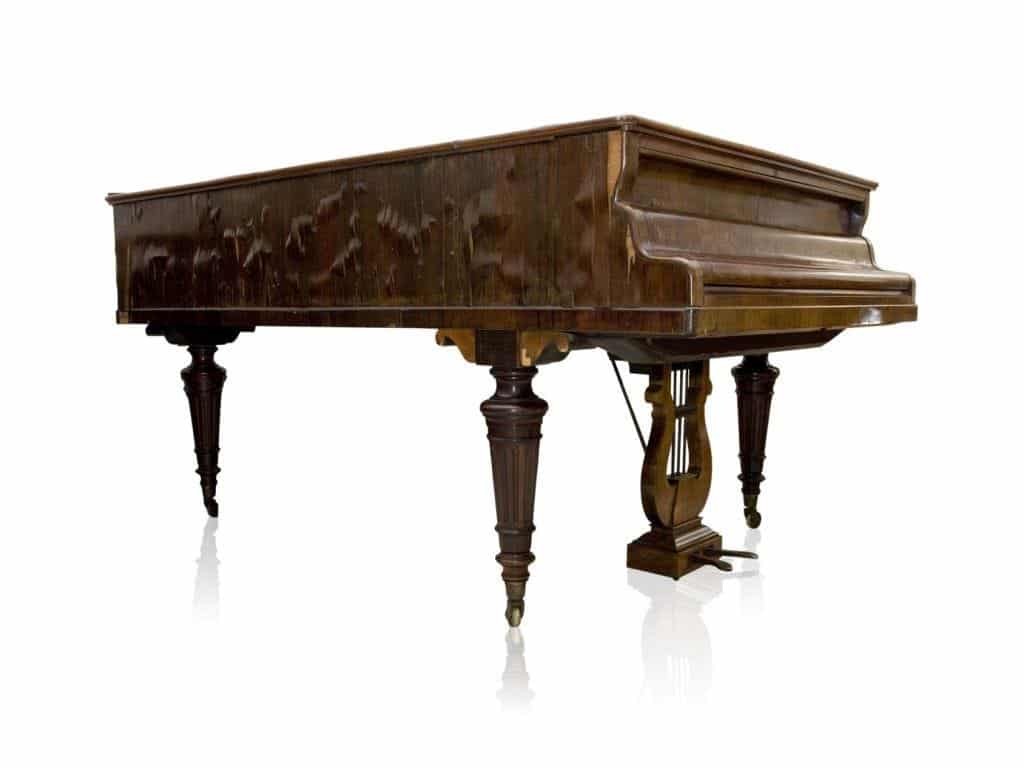
In all our services, our aim is to combine craftsmanship finesse with scientific insights in conservation. As graduate conservators, we possess comprehensive knowledge of materials, original formulations, authentic manufacturing methods, and historical construction techniques. In the conservation and restoration of various materials, such as metal fittings, leather inlays, and decorative papers, we work interdisciplinarily with other conservators and specialist workshops to achieve the best possible result for you.
The range of services offered by our wood restoration specialists at the Zentrale Restaurierungswerkstatt Berlin includes the following work:
During a restoration at ZRW Berlin, we examine your wooden object closely and can provide you with more detailed information about the object itself, such as the period of origin and the art-historical style, special features regarding the material, and, as a supplement to wood restoration, tips for optimal care. We carry out all measures with the utmost care. In doing so, we follow the principle that all interventions undertaken in wood restoration are reversible, meaning they can be undone.
Furniture Restoration in Berlin & Brandenburg
Conservation Woodwork at ZRW Berlin
The range of conservation woodwork includes numerous individual measures through which we carefully treat the wooden object while gently preserving its original substance. To restore your wooden object to its former glory, we will, for example, as part of conservation woodwork:
- clean the wooden object,
- check the stability of the construction and, if necessary, secure loose parts,
- carry out woodwork on solid or veneered wood, such as gluing, adding wood or veneer parts, or filling cracks,
- execute inlay and marquetry work,
- make movable constructions functional,
- restore the locking and closing mechanisms of chests, cabinets, doors, and drawers,
- reconstruct missing wooden parts and sections.
To determine suitable materials and formulations, wood species identification and dating, as well as analyses of binders and pigments, we employ a wide variety of scientific examination methods. ZRW Berlin is excellently equipped for this purpose. Thanks to our network and close cooperation with other specialist workshops, we can offer you the full spectrum of conservation and restoration, ensuring a seamless result.
Conservation Surface Treatments at Zentrale Restaurierungswerkstatt Berlin
Another area of service offered by our specialist workshop for conservation and restoration is conservation surface treatments. Here we employ materials and techniques that ensure your wooden object—whether large or small—is restored to new splendor. To this end, we apply our specialist expertise by:
- cleaning the wooden object,
- uncovering original surfaces,
- separating coatings,
- carrying out surface treatments, such as gluing or consolidating surfaces and adding or reconstructing painted surfaces or finishes,
- stripping,
- sanding,
- varnishing,
- polishing with shellac, oil, or wax (also according to historical formulations),
- performing retouching, such as dot and line retouching, retouching fire damage with highly stable pigments,
- executing various fillings, such as wax filler, chalk filler, shellac or epoxy resin filler.
Wood Additions and Reconstructions at ZRW Berlin
It is not uncommon for utilitarian furniture such as tables, secretaries, or cabinets to be damaged in the solid or veneered wood areas or to have missing parts. Using addition techniques, we reconstruct lost or damaged areas. To ensure the wood restoration remains inconspicuous, we visually match the missing areas to the existing surroundings through varnish and paint retouching as well as conservation consolidation (stabilization) of the wood structure. In this way, your antique furniture regains its original expressive power.
However, reconstruction of missing fragments is not always advisable. In some cases, omission even enhances historical authenticity. To determine the specific approach for your cherished piece, we as conservators ask ourselves the following questions at the outset:
- Does the retouching impair the aesthetic impact and experience of the object?
- How reconstructible is the missing wooden area?
- What technological prerequisites exist to reproduce the missing wooden parts?
- Do ethical issues arise from the wood addition?
On this basis, we develop a tailored restoration concept for your wooden object. If you wish to receive detailed restoration consultation, our specialists at the Zentrale Restaurierungswerkstatt Berlin are happy to assist you.
Wood Restorations at Zentrale Restaurierungswerkstatt Berlin
Would you like to have a wooden sculpture, a door, or antique furniture restored? Or are you looking for a specialist workshop to carry out a wood reconstruction for you? Simply contact us!
At the Zentrale Restaurierungswerkstatt Berlin, experienced graduate conservators are at your side for the professional restoration of wooden objects. With our expertise in conservation science and our care in treating historical and valuable objects, we do everything possible to restore your wooden object to the best possible condition and preserve its cultural value for posterity.
In addition to wood restorations, we also offer on-site restorations, upholstery restoration, and the restoration of archaeological cultural heritage, among other services. Please feel free to send us some overall and detail photographs of the object in question if you would like to obtain a no-obligation quotation. Our experienced wood and furniture conservators, led by Graduate Conservator (Univ.) & Joiner Philipp Westebbe, will respond promptly to arrange a personal viewing appointment with you in Berlin or Brandenburg. Within a maximum of two working days, we will prepare an individual quotation for you. With our expertise, we are available for furniture and wood restoration in Brandenburg and Berlin. We look forward to your inquiry!
Frequently Asked Questions
that you may have
Expectations regarding the results of restoration are high. In many cases, clients expect restorers to give the treated objects a like-new appearance or for a clear “before-and-after effect” to occur. However, that is not the intention of professional restoration. Good restoration remains largely invisible. Restoring does not mean “making new,” contrary to what the Latin term “restaurare” might suggest.
Restoration goes beyond conservation measures. Restoration involves direct intervention on cultural property. In doing so, its aesthetic, historical, and physical properties are respected as far as possible. It may involve making additions or reconstructions that must remain subordinate to the historic object.
For a restorer of furniture and wood, the first prerequisite is the learned trade—cabinetmaker or joiner—as the professional ethical foundation. Subsequently, during academic study, the restorer learns the scientific approach to professional restoration. Quality criteria and guidelines are derived from professional standards and the guidelines of the Association of Restorers.
The criteria of heritage conservation are more narrowly defined than those of privately practicing restorers.
Anyone expecting professional restoration should consult a qualified restorer. Unfortunately, “restorer” is not a protected designation in Germany. Anyone may carry out restoration, even without professional ethics or expertise. In the event of disputes over the outcome of the work, only civil court can provide assistance.
The task of the wood and furniture restorer is to close the missing areas in such a way that the affected area is secured. The material loss should be visually minimized by ensuring that the addition blends in as closely as possible in appearance—i.e., in color and structure. Furthermore, it must be adapted in dimension and in the given craftsmanship surface treatment to the surrounding area. Only through a professionally correctly executed addition can optical integration finally be achieved by means of color or varnish retouching. The demands on the execution quality of an addition are thus very diverse. In some cases, leaving missing areas as they are may also be considered.
The quality of additions places high demands on the professional maturity of the restorer.
Damage to antique furniture:
Just as individual as each historic object are the respective damages. They depend on many factors such as the age of the object, use, environmental influences, or care. There are some “typical basic damages” that are repeatedly observed in antique furniture.
These include:
- Shrinkage cracks—a common reaction to usually excessive room temperatures with dry air
- Breakouts—caused by mechanical impact through use
- Structural damage—loose or opened wood joints
- Wood abrasion—common in unwaxed drawers—wood rubbing on wood
- Detachment of small parts and veneers
- Stains—fading
- Surface damage in general—caused by lack of care or incorrect care
- Wear of functional metal components (locks, hinges, etc.)
- Metal corrosion
- Non-original replacement parts / poorly executed wood additions
To remedy the various types of damage requires appropriate knowledge and craftsmanship know-how. For wood additions, precisely matching wood is essential. Density, structure, and grain must be correct. Stains in wood cannot simply be removed with universal cleaners without knowledge of their origin. Improper removal can have the opposite effect, enlarging stains or making them more prominent. Wood dust created by abrasion (drawers) is frequently misinterpreted by laypeople as bore dust from “woodworm.”
Before the restorer can proceed with damage remediation, he must clarify the many individual case factors.
The following questions must be clarified in connection with a reconstruction:
- Degree of impairment to the comprehensibility and experienceability of the object
- Significance of the impairment to the aesthetic effect of the object
- Unambiguous reconstructability of the appearance of the missing area
- Technological prerequisites for the reproducibility of the missing part
- Ethical and aesthetic problems arising from the addition.
For many owners of antique furniture, restoration is an aesthetic question. One wishes to enjoy the beauty of the furniture. Other objects are old picture frames whose gilding has been damaged over the years.
For more complex measures, however, transport to my ZRW Berlin is essential.
If there are no concerns regarding functionality, wood additions are also made with naturally aged materials and comparable patina for aesthetic reasons. In furniture restoration and wood restoration, gluing or consolidation is carried out using various time-tested agents such as hide and bone glue, sturgeon glue, parchment glue, cellulose derivatives, etc.
If wood must be replaced, it comes either from the material collection of my ZRW Berlin or from well-known veneer and timber merchants in Europe. If the original furniture was already built with machine-cut knife veneer, then only knife veneer is used.
Natural varnishes are produced in our own workshop for color tone, haptics, and important surface protection.